
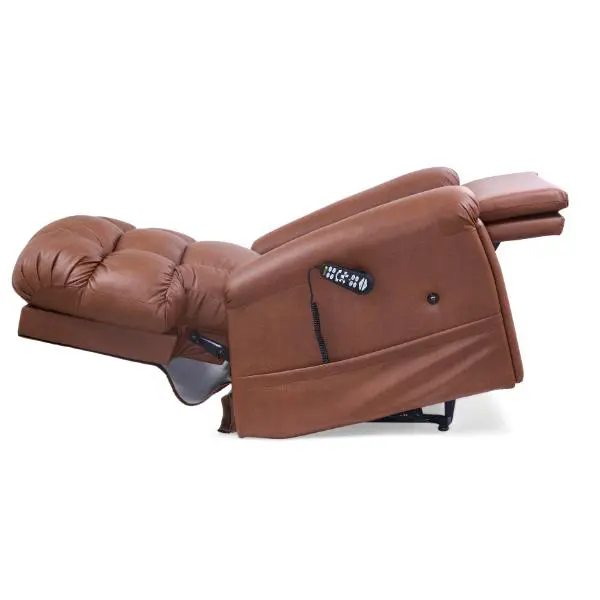
One of the biggest differences between lift chairs is how they recline. Some offer basic positioning for watching television and relaxing, while others allow you to independently adjust your backrest, footrest, headrest, and lumbar support.
Understanding the different lift chair positions can help you avoid paying for features you won’t use or purchasing a chair that doesn’t provide enough flexibility.
At All Star Medical, we encourage customers to think about how they’ll use their chair throughout the day before deciding which positioning system makes the most sense.
A 2-position lift chair offers basic reclining functionality. Despite its name, the chair isn’t necessarily limited to two fixed positions. You can typically stop the reclining motion at various points within its available range.
These chairs generally provide an upright seated position and a moderate recline.
A 2-position lift chair may be a good choice if you primarily need assistance standing up and sitting down, with occasional reclining for relaxation.
The main limitation is that the backrest and footrest generally operate together, and the chair doesn’t recline as far as more advanced models.
A 3-position lift chair offers a greater reclining range than a traditional 2-position model.
These chairs typically allow you to sit upright, recline for watching television, or lean farther back for resting.
They’re a practical option for someone who wants a comfortable everyday recliner with standing assistance but doesn’t necessarily need independent positioning controls.
A 3-position chair may work well for:
Most traditional 3-position models still operate the backrest and footrest together.
Infinite-position lift chairs typically use multiple motors to control different parts of the chair independently.
Instead of having the footrest and backrest move together, you can adjust each to find a position that feels comfortable.
For example, you might want to elevate your legs while keeping your upper body relatively upright. A traditional single-motor lift chair may not allow that combination.
Infinite-position models are particularly worth considering if you spend several hours each day in your chair or frequently change positions.
Depending on the model, you may also have access to adjustable headrests, lumbar support, programmable memory settings, and other comfort features.
The term infinite position doesn’t mean every chair offers the same range of movement. Always compare the individual model’s capabilities.
Zero gravity describes a reclining position rather than a separate motor configuration.
In this position, the chair reclines your upper body while elevating your legs, distributing your weight across the seating surface.
Many people find this position comfortable because it reduces the feeling of concentrated pressure on certain areas of the body.
Some infinite-position lift chairs include a dedicated zero-gravity setting, allowing you to reach that position with the press of a button.
If you’re considering a zero-gravity chair because of swelling, circulation concerns, or a medical condition, discuss appropriate positioning with your healthcare provider.
|
Feature |
2-Position |
3-Position |
Infinite Position |
Zero Gravity |
|
Standing assistance |
Yes |
Yes |
Yes |
Yes, on lift chair models |
|
Basic reclining |
Yes |
Yes |
Yes |
Yes |
|
Extended reclining |
Limited |
Yes |
Model dependent |
Model dependent |
|
Independent backrest and footrest |
Typically no |
Typically no |
Typically yes |
Model dependent |
|
Custom positioning |
Limited |
Moderate |
Extensive |
Model dependent |
|
Best suited for |
Basic daily use |
Everyday relaxation |
Flexible positioning |
Elevated, reclined relaxation |
Zero gravity is often a feature within an infinite-position chair rather than an entirely separate category.
Some advanced lift chairs offer a position commonly marketed as Trendelenburg or Trendelenburg-like positioning.
This generally involves reclining the body while elevating the legs above the heart.
Not every infinite-position chair offers this capability, and residential lift chairs aren’t necessarily equivalent to medical equipment designed for clinical positioning.
If you’re purchasing a chair specifically for therapeutic positioning, speak with your healthcare provider about what is appropriate for your condition.
Reclining positions aren’t the only differences between lift chairs.
Manufacturers such as Pride Mobility and Golden Technologies offer models with features that may include:
These features vary by model. Think about which ones would genuinely improve your daily comfort rather than choosing a chair based on the number of available features.
Medicare Part B may cover a medically necessary seat lift mechanism when specific eligibility requirements are met. It generally does not cover the upholstered chair itself or optional comfort upgrades.
The CMS coverage determination for seat lift mechanisms explains the medical necessity requirements.
If insurance coverage is part of your purchasing decision, confirm your eligibility before choosing a chair.
Not necessarily. Infinite-position chairs offer greater flexibility, but a 3-position chair may provide everything you need at a lower price.
No. Reclining capabilities vary between manufacturers and individual models.
No. Infinite position describes adjustable positioning capabilities, while zero gravity describes a particular reclining posture.
Many infinite-position chairs allow this because they feature independently controlled backrests and footrests.
The difference between lift chair positions becomes much clearer when you can experience them yourself.
Visit our Hermitage showroom or Brentwood showroom to compare different positioning systems, seating styles, and comfort features.
At All Star Medical, we can help you find a chair that fits your body, your mobility needs, and the way you spend your day. You can also request a virtual consultation if visiting a showroom isn’t convenient.
3520A Central Pike
Hermitage, TN 37076
615-730-9438
332 Southgate Ct
Brentwood TN 37027
615-567-6116
Monday-Friday: 9am-5pm
Saturday & Sunday: Closed

[copy content=”PIN6″]Click here to copy to clipboard[/copy]